
Would changes to the existing setup resolve these problems? Or would reviewing branch connectivity and remote access together through SASE make operations easier? The answer starts with understanding where routine support work gets held up.
Where Separate Connection Paths Add Work
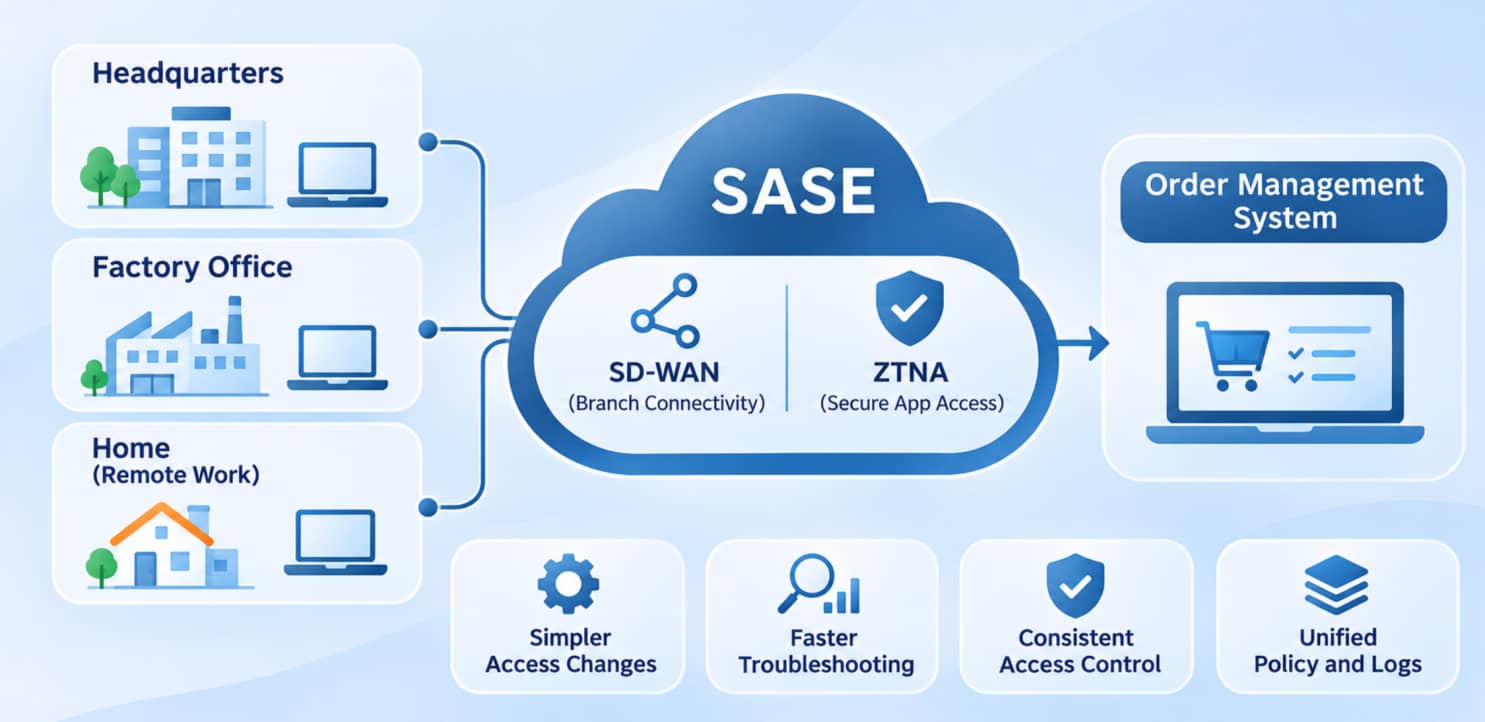
Headquarters and the factory office connect through their site networks, while employees working from home use a VPN to reach internal systems. If a remote employee cannot access the order management system, IT checks whether the VPN connection is established, whether traffic can reach the system and whether the application permits access.The investigation crosses teams when different people manage the connection, VPN and application. As more sites are added, tracking the routes and settings involved can become harder.
Start by identifying which checks take the most time during access changes and incident investigations. That gives the team a specific operational problem to assess.
What Changes with SASE
SASE, or Secure Access Service Edge, combines networking and security functions in an architecture centred on cloud-delivered services. In this example, SD-WAN manages traffic paths for branch connectivity, while Zero Trust Network Access, or ZTNA, controls access to business applications based on conditions such as user identity and device status.The connections supported, and the extent to which policies and logs can be managed together, depend on the products and deployment design.
Once a user can connect to the order management system, the application still determines whether they can view or amend an order. If a role change only requires an update to permissions within the application, review that application’s access management process.
Identifying the setting that causes the difficulty helps establish which parts of the problem a SASE deployment could address.
When a Broader Review Makes Sense
If the immediate requirement is to restrict remote employees to the order management system, first check whether the existing VPN can limit traffic to the required destinations. If access needs to be controlled at the application level, confirm that the application’s protocols and dependencies are supported by the proposed access solution.SASE becomes a candidate for comparison when branch routing also needs attention and remote access policies or incident investigations create recurring work.
Compare the current and proposed operating procedures step by step. When an employee changes roles, which settings need updating, where are those changes made and how is access verified? During a connection failure, who checks which logs?
Use those procedures to establish whether the proposed design reduces configuration work and the number of teams involved in an investigation.
Test the Order Management Workflow Before Deciding the Scope
Test access from headquarters, the factory office and a home connection. Go beyond signing in. Confirm that employees can receive order data and generate the reports or documents used in their daily work.Also test whether devices that fail the agreed access conditions are blocked, and whether support staff can identify the reason in the logs. Before testing begins, agree who can authorise a rollback and what conditions require a return to the previous connection path.
At the factory, distinguish office access to business applications from maintenance providers’ remote connections to production equipment. Define which traffic is included in the pilot. If changes affect equipment maintenance access, agree the maintenance window and assess the impact of an interruption with the equipment team and service provider.
Record how many settings a role change requires, which logs and support contacts an access incident involves, and how long a rollback takes. Compare these results with the same tasks under the current setup. Use the findings to decide which parts of the IT infrastructure to migrate and what operational support the new arrangement requires.
References
1.NIST. SP 800-215 — Guide to a Secure Enterprise Network Landscape.
2. Japan Automobile Manufacturers Association. Automotive Industry Cybersecurity Guidelines.